Reviews May Contain Minor Spoilers

If you're reading a review you should expect to hear some spoilers. I try to keep them to a minimum though.
Showing posts with label H.G. Wells. Show all posts

Saturday, 26 January 2013

War of the Worlds 2005

I've gone through the novel, the audio and the 1953 film version, so now it's time for the second feature film:

War of the Worlds (2005) is an interesting blend of all the previous versions of the the story and probably the best big budget science fiction remake of the aughts.

Impressions
We get our standard 'War of the Worlds' into read by the voice of God himself, Morgan Freeman. Our main character, Ray Ferrier, leaves his job and gets his kids for the weekend. His son refuses to even acknowledge him and even his daughter seems disappointed to be there. After they settle in, a lightning storm appears and strikes one spot multiple times. This leaves a tiny hole that is cold around the impact site. Soon that area cracks and caves in and giant mechanical tripod emerges. It howls and fires its heat ray, vaporizing those around it. Ray escapes and goes to try and get his kids out of harms way.

This film has some great scenes that are more daring and striking than most studio films dare to be. The scene where Ray realizes that he's covered in human ash is a very effective addition that I never would have thought to add. There's also the river scene where Rachel sees hundreds of bodies floating down the river. Not to mention the confrontation about the van. These help the fact that we're dealing with a story most people know and the anticlimactic nature of the ending. Even issues with the characterization are forgiven in this harrowing film.

Our Heroes
Ray Ferrier is a deadbeat Dad who works the docks and is taking care of his estranged kids for the weekend. He's good with cars, which comes in very handy as he solves the EMP issue. The character growth isn't a huge change by the end, but the things he is put through leave a definite mark. He is a loathsome character at the beginning and an okay one by the end.

Fleeing Observers
Rachel is his overly intelligent and inquisitive daughter. She is allergic and has back problems... These stupid, forgettable quirks aside, her character is actually used effectively in the film. Dakota Fanning gives one of her most convincing impersonations of a human child that I've seen.

Robbie is Ray's delinquent son proves more capable and less stupid as the movie progresses. His real turning point comes when he saves some individuals cling to a ferry as it flees the martians. Unfortunately, his fatal character flaws that involve a strange fetishization of the military. This isn't explored much from his point of view, but leads to some more character building for Ray.

Harlan Ogilvy is a man who gives them shelter near the end. He's a combination of the curate and the artilleryman of the novel, and the combo really works. His scenes are a blend of several that take the suspense of the novel with some of the visuals of the classic film. It even takes the best scene of novel and takes it to an uncomfortable extreme.

Spielberg 'Bad' Aliens
Foes from Another World!
In this version the martians arrive in electromagnetic lightning storms, similar to the EMP used in the 1953 film. They also have shields, again from the '53 version. The heat ray is present, but once again they are without their siege weapon, the black smoke. In this version the martians buried their tripods on earth in the past and came down in small lightning propelled pods. The martian tripods are cool, but the actual martians themselves looked too similar to standard Hollywood aliens for my taste, though this film does bring back their original motivation for invasion. Yes, I know they're never called 'martians' in the film, but calling them 'unnamed Spielberg aliens' would be really irritating. I'm just going with martians to keep it consistent. Spielberg never names his alien races anyway.

War Torn Atmosphere
"Is it terrorists?" This film clearly shows the date through cinematography and style. It is right in between 9/11 and the economic crash. This film has all the sense of terror and destruction that I found lacking in the previous one. As the world descends into chaos, humans become as great a threat as the martians (if not greater). The scenes of destruction are palpable and incredibly rendered.

In the End
The end is faithful to the original with an overly sappy end for our main characters. There is a bit where the army takes down an already dying tripod that I'm not sure why it was added, other than to add in an homage to the 1953 film. They did kind of edit the 'man's responsible stewardship' message, but most of the intent is there. This includes a reading directly from the end of the book by Morgan Freeman.

Overall
Tom Cruise singing "Little Deuce Coop" was a definite low point of the film, but it's really just on of some minor personal issues with this. I feel this film actually helps me justify watching the '53 version and one ups it by incorporating more of the novel. This film provides a gripping reinterpretation of the story in a big action blockbuster. Be sure to check it out.
7.5/10

Finally, I don't end on a low note! Looking at my plans for the future, I don't think they'll stay that way.

Also see as I review the rest of Spielberg's movies in:

Friday, 25 January 2013

The War of the Worlds 1953

After the novel and the audio, we arrive at the first film version.

The War of the Worlds (1953) is the first film version loosely based on the classic novel.

Impressions
This version begins by going through the first two World Wars in a documentary style. Then it explains why the martians chose Earth over the other planets. Then people notice a blue fireball descending from the sky. It lands outside Los Angeles. It's too hot to get near, so they leave three men to watch it and head off to a square dance. Soon a the capsule begins unscrewing and an eye stalk emerges and sprays the three men with sparks.

The voiceover and 'documentary footage' break in at several time to address the 'world' aspect of the film. This removes the claustrophobic viewpoint of both the novel and audio. It provides its own unique view, but it comes of as rather transparent and flat... just like most of the characters. Then there's our shoved in theme that'll I'll come back to later, let's just start with: "Six days... the same amount of time that it took to create it."

Our Heroes
Dr. Forrester is our dashing science hero. We get a minimal bio on him that mostly adds up to invincible hero. We have gone far from our everyman here. Though he does slay a martian with a wood plank, so points for that, I guess.

Fleeing Observers
Sylvia Van Buren is the love interest. Yep, it is incredibly blatant. She does pretty much nothing else, but scream and cook, despite being a science teacher.

Her uncle is Pastor Collins. He portrayed as a nice priest. After the martians appear, though, he goes kind of crazy and blabbers about them being "closer to God"because of their higher technology. Unlike the curate of the novel, the pastor's death is given an odd amount of reverence which leads into the end...

Foes from Another World!
There are some natural short cuts such as the martians walking on invisible legs and redesigned martians to accommodate an actor. The martians receive shields which I guess is an upgrade, but the black smoke is gone. Also gone is the reason that the martians came to Earth. Apparently, they just came to destroy everything. Toward the end they are even shown indiscriminately blasting a city. Also, most of the info given, that they arrive in threes and their sweeping patterns isn't used in the plot.

War Torn Atmosphere
This story starts in the long stretches of nothing with sparse towns in California. There is a lot of small talk from every character. The three human outlines in ash were a hilarious touch though. There is a wink and a nod to book when it mentions the martians found a significant base in the British Isles.

In the End
"We were all praying for a miracle!" Yep, this move credits a literal deus ex machina. I realize that they give the scientific reason, but it is covered in prayer and hymn music. If you like religious films, then this ending is probably great, but I do not. This is an unnecessary addition that defeats the original purpose of the novel's bringing men down to the level of animals and making us appreciate our dominion more. I know they use some similar lines to the novel, but this movie ends on a hymn and a sunrise over a church. Subtle. Also, did Dr. Forrester check that alien's pulse at the end?

Overall
I think my biggest problem with this film is that, while many nations are mentioned being defeated, the U.S. is never shown as being truly destroyed. At worst, the main characters are briefly stranded and then wind up in a place surrounded by healthy looking people. Even the powered up martians don't feel all that threatening. That combined with the tacked on religious overtones make this a lackluster version. I like to point out this film to prove that I definitely don't love all the older versions of Science Fiction films. Objectively, however, this film isn't all that bad on its own, it just ends up being an average alien invasion. I'd stick to the novel and audio though.
5/10  (on its own) 3/10 (if compared to the original or the radio broadcast)

I'll finish up this series with Spielberg's 2005 version tomorrow.

Thursday, 24 January 2013

The War of the Worlds ~Orson Welles~

Yesterday I looked at H.G. Wells' classic The War of the Worlds. So, today, I naturally start with the films, right? No way. I love audio and, in a time before T.V., there used to be more dramas on the radio. In fact, the director of Citizen Kane and Touch of Evil produced an audio version for Halloween!

The War of the Worlds (1938) By: Orson Welles and the Mercury Theatre on the Air

Impressions
A news broadcast interrupts its main news to report several blue flashes on Mars. Scientists speculate about the causes, but the broadcast continues to some dancing music. They cut back to a meteorite that eventually crashes in New Jersey. Creatures emerge and, as the citizens make gestures of peace, the aliens set up a mirror device. The line cuts. The next report is about sixty people being incinerated and the New Jersey militia is mobilizing.

If all that sounds fairly familiar, that's because it is nearly the exact chain of events that occurs in the novel. The difference is the presentation. The terror is in the invasion of normalcy and it is invading the listener's life. We don't even have a main narrative until the last twenty minutes, but it all works to great effect.

Our Heroes
Professor Richard Pierson is a scientist who initially dismisses speculation about life on Mars. We hear only snippets from him at the start before he takes over reading from his journal at the end. This character is played by the great Orson Welles and despite his limited appearance, he is much more relatable than the narrator from the novel.

Fleeing Observers
Those that aren't killed, flee into the night. This audio is not kind to any of its characters, though the novel wasn't very kind either.

Foes from Another World!
We get less of a description of the martians, but they seem more powerful. THe description of how they look is similar to the novel. They are certainly more threatening in their mystery. Their weapons also appear more powerful than the novel as they tear apart and resist the modern weapons of war.

War Torn Atmosphere
It feels fantastic to sit back and pretend it's Halloween Eve (October 30th) in 1938. You hear the martians invade and the cameras go dead. You hear the grim reports of the destruction of the heat rays and the ominous advance of the black smoke. This is a relic of the golden age of radio, before television and film all but destroyed the medium, and it is a jewel of the era.

In the End
It isn't until the last twenty minutes that we switch back to out protagonist reading his journal to the public. We get the encounter with the artilleryman updated to being a militiaman. The end is largely the same, though somewhat updated and abridged. It is still great including the gravitas Welles himself brings to the performance.

Overall
Orson Welles preserves the most compelling parts of H.G. Wells' classic by adapting them to 1938 America. This is a much condensed story, but it definitely eliminates the excess while keeping the core of the story alive. When originally broadcast, this caused many people to panic aneven flee the Eastern seaboard despite the warnings of it being a dramatization. Many later updated broadcasts even caused their own panics. Is it better than the novel? This is my favorite version of The War of Worlds. All the drama and excitement, but none of the excess or forced messages that we'll see tomorrow.
10/10

Tomorrow, I take a look at the first film version from 1953...

Wednesday, 23 January 2013

The War of the Worlds ~H.G. Wells~

Continuing the science fiction resolution, I've decided to dive into The War of the Worlds by the great H.G. Wells.

The War of the Worlds (1898) By: H.G. Wells

Impressions
Several flares fire from the surface of Mars. The scientific community is abuzz with theories. Then, out side the town of Woking in Surrey, a meteorite crashes. Men observe a silver capsule and the end is slowly unscrewing. Assuming there must be men inside, many people gather around, but what emerges isn't a man. The martians incinerate most of the onlookers with a heat-ray and our narrator barely escapes.

The War of the Worlds is a claustrophobic first hand account of a martian invasion of earth.We follow an unnamed narrator who is privy to the main events of the martian invasion of Earth. We also get occasional bits of his brother's story about London falling to pieces.

Our Heroes
The Narrator is fairly nondescript upper class married Britisher. He's a sort of everyman, but the focus is really on humanity's experiences. The Narrator's brother falls into the same roll. In fact there are no named characters in the novel.

Fleeing Observers
As the social systems break down, humanity falls into chaos. Most of the passersby that they meet are half crazed. People  even die simply from all the chaos. The curious exception is a pair of ladies who meet the brother. An interestingly feminist move from Wells.

The Artilleryman is a running character who represents kind of dreamlike vision of resistance. His section at the end came across as almost more pessimistic than the scenes with the curate.

The curate is a deranged man of God who seeks the aide of our narrator. His weak will nearly spells the death of them both.

"Surely, if we have learned nothing else, this war has taught us pity--pity for those witless souls that suffer our dominion."

Foes from Another World!
The Martians emerge from their capsules as hideous chinless tentacle beasts that quickly construct massive weapons of war. Their tripods have heat rays and writing tenacle arms. They are nearly invulnerable to harm. When artillery kills one, the Martians devise poison gas grenades that decimate populations. They are an awesomely terrifying foe that is just short of invincible, but their true terror lies in their intelligence and their choice of meal.

War Torn Atmosphere
Though Wells can go overboard on the details and his prose can be a bit dated, this novel has some of the most epic and gripping descriptions. The opening chapter of this book is one of the great science fiction openings of all time.

In the End
The classic ending of a science fiction masterpiece. If you don't know the end, read a freakin' book! I absolutely love the ending and especially how it is foreshadowed at the start. The epilogue leave a sobering tone about the toll a traumatic experience can leave on the human mind. After the grim sections of the novel it is kind of incredible that it has a positive ending at all.

Overall
Despite some anachronistic language and long passages, this novel is a timeless classic. The martians are a vicious and calculating enemy. If, for some reason, you haven't read it, do!
8/10

Get it free from Project Gutenberg or Amazon!

Tomorrow, I add my first non-Doctor Who audio. Guess what it is!

Monday, 29 October 2012

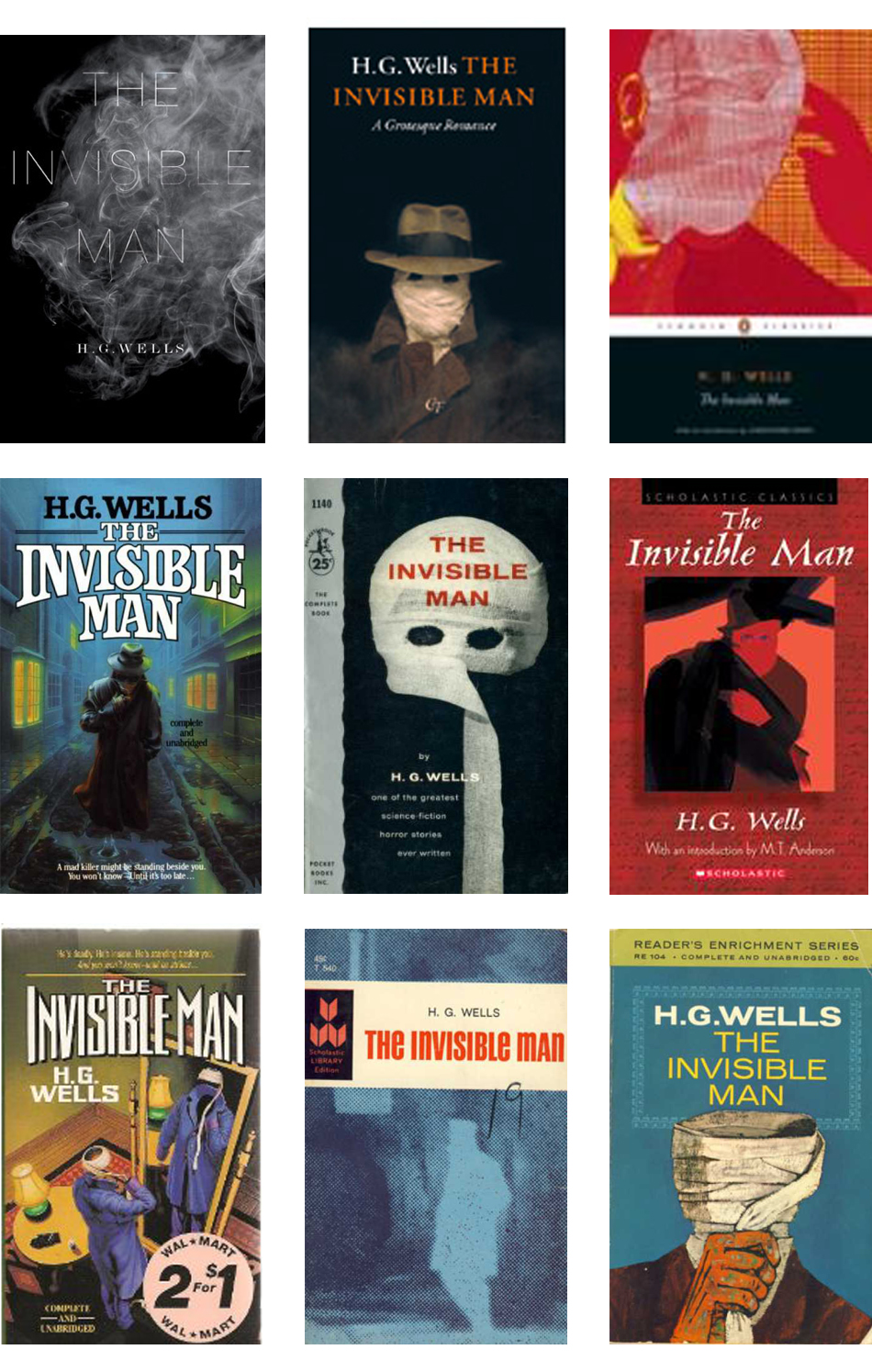
The Invisible Man - H.G. Wells -

Night 11
The Invisible Man (1897) By: H.G. Wells

Impressions
A man covered head to toe, except for his shiny nose, enters the town and begins doing strange experiments. He is strangely irritable and eccentric cursing at anyone who enters his room. Soon impossible robberies begin happening throughout the town.

The Invisible Man is an interesting novel to read since it doesn't exactly have a protagonist. We follow the observations of various townfolk who come into contact the invisible man, but, much like the Great Gatsby, we never get our protagonist's point of view. The end provides quite the payoff.

Our Villain
The invisible man starts a a potentially persecuted scientist, but we soon learn that he is a deranged madman. The funny thing is that he was always a madman even before the transformation. The movies make it seem like the serum drove him mad, but the book's idea of his own selfishness causing him to create the serum is fantastic. The slow reveal serves to build his fall and it works. The only problem is that the middle seems a bit aimless.

The Mob Mentality
Doctor Kemp is the only one who stands to compete with invisible man. It is interesting that Kemp does it by showing some compassion and trying to understand the invisible man. However, Kemp soon realizes that he's nuts and comes up with some rather inventive ways to combat him.

The others in the story range from stupid peasants to baffled onlookers. They are alright, though many of their stories seem superfluous: like cutting away from a murder to describe a little girl's point of view of the victim walking before he is killed and then saying it isn't reliable.

Atmosphere
The descriptions in this book provide a nice look back into the late 19th century. Also, the descriptions of the weakness of the invisible man as well as his strengths are rendered beautifully.

In the End
The end is a tense chase to stop the invisible man before he can subject the town to his reign of terror. It does switch to the perspective of one of Kemp's neighbors rather than staying with Kemp, as it should have. The final defeat of the invisible man is wonderfully gruesome. It ends on a sort of cliffhanger showing that an invisible man can still be made.

Overall
This book is basically dressing down the superpower of practical invisibility. Often thought of as a great power, this book proves that if you don't think through the invisibility it can be a curse. It is handled with the thoroughness that has caused Wells to be called one of the grandfathers of Science Fiction.
7/10

So read it on Project Gutenberg and Kindle!

Also, the 31 Days of Macabre Movies are still going on at The Good, The Bad, and The Magnificent! So check them out!